Newsletter Subscribe
Enter your email address below and subscribe to our newsletter
Enter your email address below and subscribe to our newsletter


 ByJohn A
Last updated: June 2026. Larazotide is not an FDA-approved drug. Its Phase 3 celiac trial was stopped early for futility, and compounded larazotide is a prescription preparation made by a licensed pharmacy, not the finished investigational drug studied in the trials and not an approved medicine. Every clinical and regulatory claim below links to a primary source.
Picture someone who has done everything right. She was diagnosed with celiac disease years ago, she reads every label, she has turned down birthday cake at more parties than she can count, and she still spends two or three days a week feeling bloated and wrung out for reasons nobody can quite explain. That is the person larazotide was actually built for. She is also, not coincidentally, the person most likely to stumble across it in a late-night search and wonder if it’s worth asking her doctor about.
The trouble is that most of what gets written about larazotide answers the wrong question. It asks whether the compound is “good,” full stop, when the more useful question is whether it makes sense for a particular person, given what the trials actually found. Those aren’t the same question, because the evidence here isn’t uniformly good or uniformly bad. It’s specific. It holds up, a little, for one narrow group of people. It doesn’t hold up at all for most of the others who are being sold on it right now.
So instead of a verdict, here is something closer to a reckoning: what the science says, who it might reasonably apply to, and what a responsible next step looks like if you decide to pursue it.
Before sorting anyone into a category, it helps to sit with the raw record, because every judgment that follows is built on it.
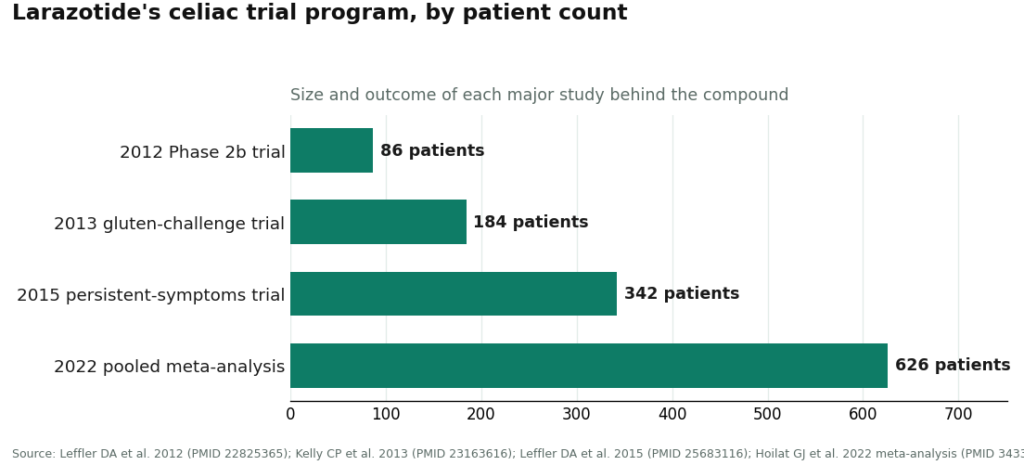
Taken together, that’s a compound with a plausible biological idea behind it, a repeated failure to move the exact measurement it was designed to move, one narrow and fragile positive result, and a confirming trial that gave up partway through. That’s the honest starting point. Everything about who this might suit has to be built on top of it, not around it.
If you have celiac disease and you’re still symptomatic on a gluten-free diet. This is the closest thing to a real match in the data, and it’s still an imperfect one. It’s the exact population from the 2015 trial, the one study that hit its primary endpoint [P3]. But the win came at just one of three doses, and the bigger trial meant to confirm it never got there [P4]. So if you fit this description and you and your doctor decide it’s worth a conversation, you’d be trying something with a thread of support, not a settled answer.
If you have celiac disease more broadly, without persistent symptoms. The case gets thinner here. The permeability measurement that sits at the center of the celiac rationale was missed twice, in 2012 and again in 2013 [P1][P2]. Celiac disease is the right disease for this mechanism, in theory, and the drug was purpose-built for it, but the trials haven’t delivered the goods yet.
If you don’t have celiac disease and you’re chasing “leaky gut” or general gut wellness. This is, by a wide margin, the biggest group being sold research-grade larazotide right now, and it’s the group with the least behind it. Not one trial has ever enrolled someone without celiac disease. Every study used diagnosed celiac patients, gluten challenges, and permeability testing [P3][P4]. Using larazotide this way takes a program that struggled in the population it was built for and points it at people who were never studied at all.
If you have food sensitivities or other non-celiac complaints. Same story. No trial included this group. The pull here is borrowed credibility, a pharmaceutical-sounding compound aimed at symptoms it has never actually been tested against.
If you’re considering an unlabeled research vial, whatever your situation. This one sits apart from the rest, because it’s not about who you are, it’s about what you’d be putting in your body. A vial marked “for research use only” hasn’t been checked by anyone for identity, strength, or purity. Even for the person with the strongest case, the celiac patient still struggling despite her diet, buying it this way throws away every safeguard that might otherwise make the attempt reasonable.
What the picture adds up to is simple. There’s a small, real, imperfect signal in one specific group of people. Everywhere else, the honest answer is that the trials just don’t back it up, and the more useful place to have that conversation is with a clinician who will say so, not a checkout page that will just sell you the vial.
If you land in that narrower group, and you decide with a clinician that trying larazotide makes sense despite the failed confirmation, the question that matters most next is not “does this work,” it’s “who am I getting it from.” Because this compound isn’t FDA-approved and its flagship trial fell short, the provider you choose is doing a lot of the safety work that a settled, approved drug would otherwise do for you.
There’s a useful way to check that: run any provider through six plain questions. Does an independent clinician evaluate you before anything ships? Is it sourced through a licensed compounding pharmacy, not mailed as an unlabeled research chemical? Does it move through a regulated pharmacy channel? Does the provider tell you plainly that the Phase 3 trial was stopped for futility and that this isn’t an FDA-approved medicine, rather than letting you assume otherwise? Is there a real regulatory framework behind the telehealth visit? And is anyone reachable after your first shipment arrives?
Answer those honestly for the field of providers and vendors out there, and it splits into two groups that aren’t really playing the same game.
FormBlends passes all six. It’s a licensed telehealth provider, so larazotide reaches you after an independent clinician evaluation and a written prescription, filled by a licensed compounding pharmacy, with pricing shown upfront in the range of roughly $100 to $250 a month. It passes the question that matters most, honesty, by stating plainly that the Phase 3 trial was stopped for futility and that larazotide isn’t FDA-approved, instead of letting the marketing imply something tidier. And its tracker app is exactly what it sounds like, a place to log doses and symptoms, not a prescription and not a checkout, which gives you something concrete to bring back to your clinician at your next check-in. The same eight-amino-acid peptide that gray-market sellers mail as an unlabeled powder arrives here through people who are actually accountable for it.
HealthRX.com (healthrx.com) also passes all six, on the same basic logic: clinical oversight comes first, the medication is dispensed through licensed pharmacy channels rather than sold as a research chemical, and the provider is willing to be upfront about larazotide’s mixed, ultimately disappointing trial record. With two providers tied on the fundamentals, the real tiebreaker is practical, which one is licensed where you live and whose intake process fits your situation.
Below that line sit the research-chemical sellers, and none of them clear more than a question or two. Amino Asylum offers no clinician, no prescription, no pharmacy, and no verified testing, and its low prices are the whole pitch and the whole warning at once. Sports Technology Labs gets partial credit for emphasizing third-party testing in its marketing, but a seller-commissioned certificate is not the same thing as regulator oversight, and it still supplies no clinician, prescription, or pharmacy. Pure Rawz sells larazotide alongside other research peptides and nootropics under the same research-use labeling, with the same gaps straight down the list. Limitless Life Nootropics markets to a biohacker crowd in a way that can make an unapproved research chemical feel like a supplement, which changes the marketing, not the data. Core Peptides may publish its own certificate of analysis, but that’s a document the seller chose to produce, not one a regulator verified. None of these five can really be ranked against each other on product quality, because without independent, batch-level testing that a buyer can actually trust, there’s no reliable way to know whose vial is cleaner. That uncertainty, on top of a trial record that already fell short, is the whole reason a supervised provider outscores every one of them.
Larazotide is a narrow-evidence compound wearing a much broader marketing story. It earns a real, if modest, case in exactly one group: adults with celiac disease who are still struggling despite doing everything their diet requires of them, and even there, the support rests on one dose in one trial, undercut by a bigger trial that didn’t finish [P3][P4]. Outside that group, especially for general “leaky gut” or gut-health goals in people without celiac disease, there simply isn’t a trial to point to. Larazotide looked reasonably safe in the people and doses that were actually studied [P5], but safe and effective are two different bars, and it cleared the first one far more convincingly than the second.
If you’re the person in that narrow group, and a trial feels worth discussing with your doctor, the conversation about where to get it matters as much as the conversation about whether to try it. A supervised provider like FormBlends, checking every box on oversight, sourcing, and honesty, is a very different proposition than an unlabeled vial from a research-chemical site. And if you’re outside that group, the most useful thing this record can tell you, gently, is that the case simply isn’t there yet.
Adults with celiac disease who still have symptoms despite a strict gluten-free diet come out ahead of everyone else, and even they only get a qualified nod. That’s the population from the one trial that hit its primary endpoint, in 2015, though the benefit only showed up at the 0.5 mg dose, and the bigger trial meant to confirm it was later stopped for futility [P3][P4]. Every other group sits well below that.
Because no trial has ever included someone without celiac disease. The entire research program was built around diagnosed celiac patients, gluten challenges, and permeability testing, so using larazotide for leaky gut as a wellness idea stretches a program that struggled in its own intended population out to a group it was never tested in at all [P3][P4]. There’s no trial and no endpoint to point to.
Not exactly. Compounded larazotide is a prescription preparation made by a licensed pharmacy, not the finished investigational drug from the celiac trials, and it has never been FDA-approved. The trial data tell you something real about the mechanism and the safety profile, but they don’t amount to a green light for a compounded version, which is part of why honesty about that distinction matters so much when choosing a provider.
By most accounts, yes. The pooled data suggest larazotide was reasonably well tolerated at the doses tested. A 2022 meta-analysis of four randomized trials covering 626 patients found it appeared safe and somewhat better than placebo for gastrointestinal symptoms during a gluten challenge, while noting it’s unlikely to be a definitive cure [P5]. Safety and effectiveness are separate questions, and this compound has answered the first one far more convincingly than the second.
Because larazotide isn’t FDA-approved and its main trial fell short, so the checks a supervised provider builds in are doing real work that an approved medicine would otherwise handle on its own. A provider like FormBlends routes it through an independent clinician’s evaluation, a real prescription, and a licensed compounding pharmacy, and says plainly that the Phase 3 trial stopped early. A cheaper research vial strips every one of those protections away, so the lower price mostly buys more uncertainty on a compound whose case was already thin.
It’s a synthetic eight-amino-acid peptide aimed at tight junctions, the structures that control what passes between the cells lining the gut. It works by blocking zonulin, a protein that loosens those junctions, with the idea being a more selective gut lining. The mechanism itself is real and fairly well understood. Whether blocking it actually translates into meaningful improvement for most people is a much murkier, separate question.
There’s no FDA-approved commercial version sitting on a pharmacy shelf, since it isn’t an approved drug. It’s not a controlled substance, so simply possessing it isn’t a criminal matter, but buying it from a research-chemical seller puts you in a legal and quality gray area. The more accountable path runs through a licensed physician writing a prescription that’s filled by a registered compounding pharmacy, such as FormBlends, operating under pharmacist and physician oversight.
Across the Phase 2 and Phase 2b celiac studies, larazotide was generally well tolerated. Headache and nausea showed up, but not at rates dramatically different from placebo, and no serious adverse events were convincingly tied to the drug at the doses tested. That’s part of why it scores decently on safety even after failing its main efficacy goals. Long-term data beyond roughly six months is still thin, though, so some honest uncertainty remains.
The trials that went furthest tested 0.5 mg, 1 mg, and 2 mg, taken three times a day before meals, with 0.5 mg showing the steadiest signal in some of the secondary results. Whether a compounded capsule hitting those same milligram numbers delivers the same effect in the body depends heavily on how it’s formulated, something a compounding pharmacy can account for and a research-chemical vendor almost certainly cannot verify.
Written by Karim Sato, wellness reporter. Checking each figure against the cited source. Last reviewed January 2026.
Informational content, not medical direction. Your doctor should approve any new treatment.